
Tuition-Free Online Middle School in Oregon
Virtual Preparatory Academy of Oregon
Middle school is an exciting time in a child’s life. Grades 6-8 are full of changes and opportunities for all students. Yet, the traditional classroom experience may not be the best fit for everyone. Virtual Prep Academy of Oregon’s tuition-free, accredited online middle school offers a safe, secure learning experience. Here, there’s both flexibility and support. Distraction-free learning at a personalized pace is available for all students.
Learn how online middle school can benefit your family. Explore all Oregon Virtual Preparatory Academy admissions information and enroll online today.
How Online Middle School Works
Much of an online education is like traditional schooling. Core classes, peer support, and 1:1 teach interactions are part of the day-to-day experience. There are opportunities for field trips, and virtual family nights. Middle schoolers at Virtual Prep Oregon follow a structured blend of live instruction and self-paced assignments. Support systems engage learners with unique needs so they can meet academic and personal goals. This inspiring structure fosters accountability and independence among Oregon middle school students.
Structured Days with Flexible Learning Time
As part of their daily routine, students engage in teacher-led lessons and self-directed study. This blend helps them stay focused while developing time management skills. Our virtual middle school model gives students flexibility and freedom to study at their own pace without sacrificing accountability or social connection.
Certified Teachers Who Know How to Engage Tweens
Our Oregon-licensed educators offer live lessons. Small group work engages students at this exciting age. With personalized check-ins, you know your student has the support they need to thrive through middle school and beyond.
Digital Tools That Support Academic Growth
Online learning is only as good as the digital tools students have access to. Our virtual middle school education platforms encourage critical thinking, smart multimedia learning, and the development of strong writing skills. This foundation prepares students for education and career paths in the digital age.
Benefits of Online Middle School
The traditional middle school environment may work for some students, but it’s not ideal for all. Alternative school opportunities like the virtual middle school in Oregon at VPREP support middle schoolers who need flexibility, safety, and customized instruction to truly thrive. Our program helps children transition into adolescence with confidence and the necessary skills to thrive in and outside the classroom.
Safe, Inclusive Environment for All Students
The benefits of online middle school programs make learning safer for all students. Free of distractions, peer pressure, and bullying, virtual learning lets children focus on the important things: their studies and academic growth.
Schedule Flexibility for Family Life
The traditional school schedule doesn’t fit all lifestyles. Working parents and busy students appreciate how virtual learning offers broader opportunities for those with unique routines, extracurricular involvement, work commitments, and caregiving responsibilities.
Personalized Pace and Academic Coaching
No two learners are the same. Some students require additional help and time to conquer subjects. Others wish to be challenged by advanced coursework. When your child needs to catch up or move ahead, our teachers can adapt their lessons to meet your student’s academic goals.
Comprehensive Online Middle School Curriculum
VPREP Oregon’s academic programs include a state-aligned, accredited online middle school curriculum that meets learning standards and engages students with the material. Rigorous core classes and enrichment opportunities challenge your child to reach their highest potential. Our licensed teachers focus on the following subject areas:
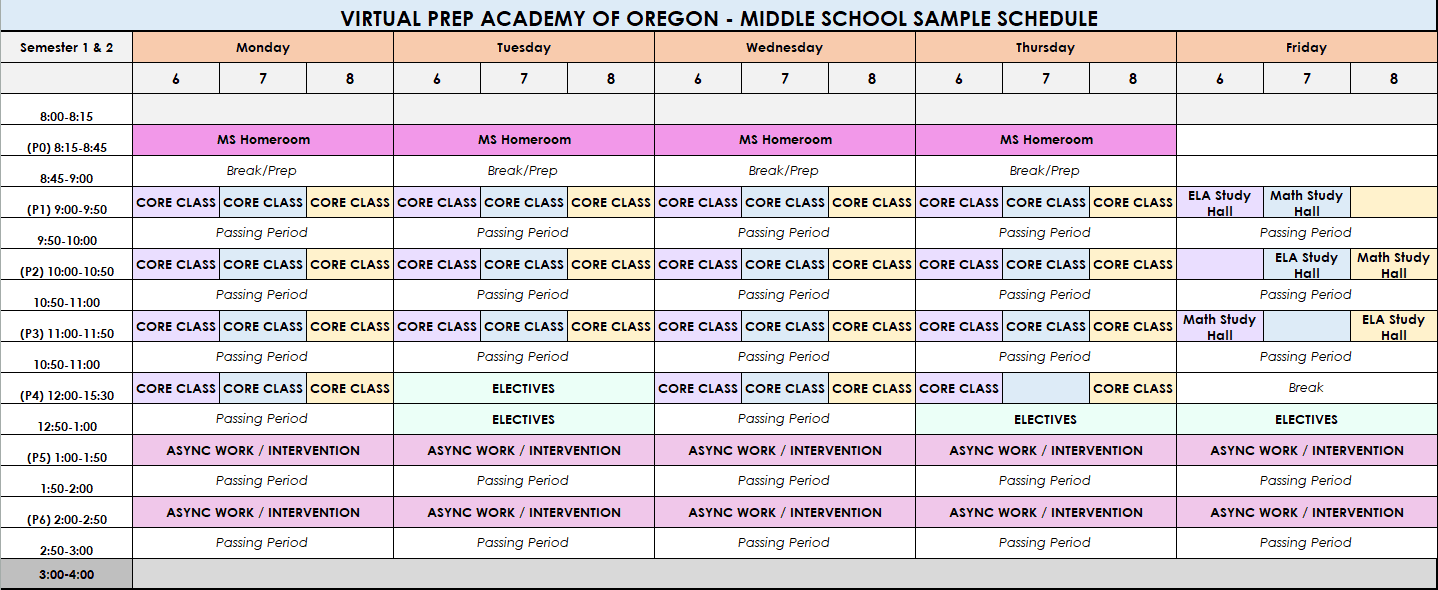
Sample 6-8 Schedule
Curriculum, Grades 6-8
* Course offerings are subject to change and may vary based on school staffing
LANGUAGE ARTS
Middle school students are able to independently read increasingly complex text, as well as respond in writing to these same texts. Readings include classic short stories and a variety of informational texts related to historical topics. Students will also have the opportunity to read and study a novel of their choice. Each unit in 6th grade Language Arts includes explicit instruction and practice in writing, grammar, morphology, spelling, and reading.
Grade 6 writing expands in scope and complexity, consisting of a robust series of unit- long writing activities that incorporate language skills and focus on developing craft and structure while incorporating and building upon writing skills learned in the earlier grades. These writing projects are intended to prepare middle school students for the writing they will do in high school, college, and the professional world.
The semester culminates with a project in which students apply the learning from the semester to complete a comprehensive activity. The projects are intended to promote independent learning as students make choices about work products and apply self- management skills to plan activities.’
MATH
A: In this problem-based curriculum, students will build on their math skills through exploration. Throughout this course, students will use interactives and offline tools to explore math concepts. Students learn by doing math, solving problems in mathematical and real- world contexts, and constructing arguments using precise language. Students hear thoughts and ideas from their “virtual classmates” as they explore mathematical concepts and are encouraged to explain their thinking in writing throughout the course.
Students begin the year exploring geometry through the study of area and surface area of figures. They then move into a study of ratios, unit rates, unit pricing, and percentages. The semester concludes with an in- depth dive into dividing fractions, focusing not only on algorithms, but also conceptualizing and applying this skill. Additional course elements include real- world applications, discussions, graphic organizers, and unit projects.
B: In this problem-based curriculum, students will build on their math skills through exploration. Throughout this course, students will use interactives and offline tools to explore math concepts. Students learn by doing math, solving problems in mathematical and real- world contexts, and constructing arguments using precise language. Students hear thoughts and ideas from their “virtual classmates” as they explore mathematical concepts and are encouraged to explain their thinking in writing throughout the course.
Students begin this semester by exploring decimals, and learn how to perform operations with decimals in context of real- world situations and problems. They then begin to delve into algebraic concepts such as expressions, expressions with exponents, and equations with one variable. Students begin to learn about negative numbers and plot positive and negative numbers on a coordinate grid. Finally, students explore data analysis and statistical questions through the study of dot plots, histograms, median, IQR, and measures of center. Additional course elements include real- world applications, discussions, graphic organizers, and unit projects.
SCIENCE
In this inquiry-based curriculum, students engage with science questions with the goal of explaining a phenomenon and/or solving a problem. Students begin by posing questions, developing models, proposing ideas for investigation, investigating and gathering data, applying data to answer questions and revise models, and then forming new questions to answer. They question, investigate, and build understanding as they read, complete interactive activities and simulations, and engage in virtual labs.
A: Students begin the semester with a study of light and matter, exploring the phenomenon of one- way mirrors which act as both a window and a mirror. They will investigate how light transmission and reflection impacts how we see an object. Next, they will study thermal energy and learn how containers can keep materials hot or cold. During this study, they will investigate closed and open systems and the movement of particles. Finally, they will learn about cells and systems. Students will explore the systems of the body and investigate how we heal from injuries at a cellular level. Additional course elements include readings, discussions, and unit projects.
B: Students begin the semester with a study of weather, climate, and water cycling. They investigate the movement of air in the atmosphere and the impact that it has on the weather. Students explore precipitation and storms and investigate why some storms are more severe than others. Next, student will learn about plate tectonics and rock cycling. They study Earth’s surface and how tectonic plate movement has impacted land. Finally, students will focus on tsunamis as they investigate natural hazards and how to prepare for them. Additional course elements include readings, discussions, and unit projects.
SOCIAL STUDIES
A: Sixth grade students will study the beginning of early civilizations through the Gupta dynasty. Students will examine the geographical, social, economic, and political foundations for early civilizations progressing through the Gupta dynasty. They will analyze the shift from nomadic societies to agricultural societies. Students will study the development of civilizations, including the areas of Mesopotamia, Egypt, Ancient Israel, and India. The study of these civilizations will include the impact of geography, early history, cultural development, and economic change. The geographic focus will include physical and political features, economic growth and resources, and migration patterns. This class will conclude with the Gupta dynasty.
B: Students explore the geographic, political, economic, and cultural development of Ancient Greece, Rome, and China. The course examines the birth and spread of Judaism, Christianity, Taoism, and Confucianism. Students apply historical thinking skills to understand the implications of ancient literature, art, and philosophy on later Western culture.
LANGUAGE ARTS
A: Middle school students are able to independently read increasingly complex text, as well as respond in writing to these same texts. Readings include classic short stories and a variety of fiction and nonfiction selections from the Harlem Renaissance, as well as a student- friendly version of Strange Case of Dr. Jekyll and Mr. Hyde. Students will also have the opportunity to read and study a novel of their choice. Each unit in 7th grade Language Arts includes explicit instruction and practice in writing, grammar, morphology, spelling, and reading.
Grade 7 writing expands in scope and complexity, consisting of a robust series of unit- long writing activities that incorporate language skills and focus on developing craft and structure while incorporating and building upon writing skills learned in the earlier grades. These writing projects are intended to prepare middle school students for the writing they will do in high school, college, and the professional world.
The semester culminates with a project in which students apply the learning from the semester to complete a comprehensive activity. The projects are intended to promote independent learning as students make choices about work products and apply self- management skills to plan activities.
B: Middle school students are able to independently read increasingly complex text, as well as respond in writing to these same texts. Readings include classic and contemporary poetry as well as student- friendly versions of Shakespeare’s The Tempest and The Time Machine by H.G. Wells. Students will also have the opportunity to read and study a nonfiction work of their choice. Each unit in 7th grade Language Arts includes explicit instruction and practice in writing, grammar, morphology, spelling, and reading.
Grade 7 writing expands in scope and complexity, consisting of a robust series of unit- long writing activities that incorporate language skills and focus on developing craft and structure while incorporating and building upon writing skills learned in the earlier grades. These writing projects are intended to prepare middle school students for the writing they will do in high school, college, and the professional world.
The semester culminates with a project in which students apply the learning from the semester to complete a comprehensive activity. The projects are intended to promote independent learning as students make choices about work products and apply self- management skills to plan activities.
SCIENCE
In this inquiry- based curriculum, students engage with science questions with the goal of explaining a phenomenon and/or solving a problem. Students begin by posing questions, developing models, proposing ideas for investigation, investigating and gathering data, applying data to answer questions and revise models, and then forming new questions to answer. They question, investigate, and build understanding as they read, complete interactive activities and simulations, and engage in virtual labs.
A: This semester begins with an investigation of bath bombs and the chemical reactions that happen when they are placed in water. Students will learn how matter can change forms while total mass remains the same. Next, students continue their study of chemical reactions as they learn about chemical reactions and energy. They investigate how to heat up food and how to create a flameless heater. Finally, they will explore ecosystems and how changing an ecosystem impacts living things. They will study the impact of various products on rainforests and on the plant and animal life within them. Additional course elements include readings, discussions, and unit projects.
B: This semester begins with a study of metabolic reactions. Students will learn about what happens to food molecules as they pass through the digestive system and will study the chemical reactions that happen within the human body. Next, students will investigate how plants get their food and the cycling of matter in the plant life cycle. Finally, students will study the impact of humans on Earth’s resources and will learn strategies to work together to help battle climate change and changes to our atmosphere. Additional course elements include readings, discussions, and unit projects.
MATH
A: In this problem- based curriculum, students will build on their math skills through exploration. Throughout this course, students will use interactives and offline tools to explore math concepts. Students learn by doing math, solving problems in mathematical and real- world contexts, and constructing arguments using precise language. Students hear thoughts and ideas from their “virtual classmates” as they explore mathematical concepts and are encouraged to explain their thinking in writing throughout the course.
Students begin the year exploring relationships between figures as they examine scaled copies and scale drawings. This transitions into learning about proportional and nonproportional relationships as well as how to represent proportional relationships with tables, graphs, and equations. Next, students learn about relationships within circles: measuring circles and finding the area and circumference of a circle. Finally, students conclude their study of proportional relationships by studying proportional relationships with fractions, percent increase and decrease, and application of percentages. Additional course elements include real- world applications, discussions, graphic organizers, and unit projects.
B: In this problem- based curriculum, students will build on their math skills through exploration. Throughout this course, students will use interactives and offline tools to explore math concepts. Students learn by doing math, solving problems in mathematical and real- world contexts, and constructing arguments using precise language. Students hear thoughts and ideas from their “virtual classmates” as they explore mathematical concepts and are encouraged to explain their thinking in writing throughout the course.
Students begin this semester with rational number arithmetic, learning how to interpret negative numbers and complete all 4 operations with rational numbers. They are also introduced to solving equations with negative numbers. Next, students apply their skills to solving expressions, equations, and inequalities, as well as writing equivalent expressions. Students then transition to geometry, working with angles, triangles, and prisms. They study relationships between angles and learn how to draw figures with given specifications. The course concludes with a study of probability of single- and multi- step events and sampling. Additional course elements include real- world applications, discussions, graphic organizers, and unit projects.
SOCIAL STUDIES
A: This seventh-grade course explores Europe, Africa, and Asia’s social, cultural, and technological changes in AD 500–1789. After reviewing the ancient world and how archaeologists and historians uncover the past, students study the history and geography of great civilizations developing concurrently throughout the world during medieval and early modern times. These include the Roman Empire, the early Muslim empires, and empires in Africa, the Americas, and East Asia.
B: In this second segment of the course, students study the Renaissance, Reformation, and the Age of Exploration, examining the growing economic interaction among civilizations. Students learn about the exchange of ideas, beliefs, technologies, and commodities. They study the resulting growth of Enlightenment philosophy and the new examination of the concepts of reason and authority, the natural rights of human beings and the divine right of kings, experimentalism in science, and the dogma of belief. Finally, students assess the political forces let loose by the Enlightenment, particularly the rise of democratic ideas, and they learn about the continuing influence of these ideas in today’s world.
LANGUAGE ARTS
B: Middle school students are able to independently read increasingly complex text, as well as respond in writing to these same texts. Readings include classic short stories and a variety of fiction and nonfiction selections from the Harlem Renaissance, as well as a student- friendly version of Mary Shelley’s Frankenstein. Students will also have the opportunity to read and study a novel of their choice. Each unit in 8th grade Language Arts includes explicit instruction and practice in writing, grammar, morphology, and reading.
Grade 8 writing expands in scope and complexity, consisting of a robust series of unit- long writing activities that incorporate language skills and focus on developing craft and structure while incorporating and building upon writing skills learned in the earlier grades. These writing projects are intended to prepare middle school students for the writing they will do in high school, college, and the professional world.
The semester culminates with a project in which students apply the learning from the semester to complete a comprehensive activity. The projects are intended to promote independent learning as students make choices about work products and apply self- management skills to plan activities.
B: Middle school students are able to independently read increasingly complex text, as well as respond in writing to these same texts. Readings include classic and contemporary poetry as well as student- friendly versions of Narrative of the Life of Frederick Douglass and The Importance of Being Earnest by Oscar Wilde. Students will also have the opportunity to read and study a nonfiction work of their choice. Each unit in 8th grade Language Arts includes explicit instruction and practice in writing, grammar, morphology, and reading.
Grade 8 writing expands in scope and complexity, consisting of a robust series of unit- long writing activities that incorporate language skills and focus on developing craft and structure while incorporating and building upon writing skills learned in the earlier grades. These writing projects are intended to prepare middle school students for the writing they will do in high school, college, and the professional world.
The semester culminates with a project in which students apply the learning from the semester to complete a comprehensive activity. The projects are intended to promote independent learning as students make choices about work products and apply self- management skills to plan activities.
SCIENCE
In this inquiry- based curriculum, students engage with science questions with the goal of explaining a phenomenon and/or solving a problem. Students begin by posing questions, developing models, proposing ideas for investigation, investigating and gathering data, applying data to answer questions and revise models, and then forming new questions to answer. They question, investigate, and build understanding as they read, complete interactive activities and simulations, and engage in virtual labs.
A: This semester begins with a study of motion and contact forces. Students will investigate how changing the mass or speed of an object can affect forces in a collision, as well as learn ways to protect objects in a collision. Next, students investigate sound and how sounds can make matter move. They study sound waves and frequency and examine the effects of different pitches and volumes of sounds. Finally, students continue their study of forces by investigating magnets and the forces that they can apply on objects. They investigate magnetic fields, energy transfer, and the force pairs in magnetic fields. Additional course elements include readings, discussions, and unit projects.
B: This semester begins with an exploration of patterns in the sky and in space. Students investigate phenomena with the Moon, Sun, and other objects within and beyond our solar system. Next, students explore the world of genetics, as they learn how traits are passed from parents to offspring. They model trait variations and learn about the reproduction of plants and animals. Finally, students explore the connection between living beings of today and those of long ago as they investigate the process of natural selection. They engage in case studies about population changes and the impact of the environment on various living beings. Additional course elements include readings, discussions, and unit projects.
MATH
A: In this problem- based curriculum, students will build on their math skills through exploration. Throughout this course, students will use interactives and offline tools to explore math concepts. Students learn by doing math, solving problems in mathematical and real- world contexts, and constructing arguments using precise language. Students hear thoughts and ideas from their “virtual classmates” as they explore mathematical concepts and are encouraged to explain their thinking in writing throughout the course.
This semester begins with an in- depth study of transformations. Students first learn about rigid transformations and congruence of shapes and angles in triangles. They then expand this knowledge to work with dilations and similarity of figures. Next, they begin to explore linear relationships as they find slopes and solve and graph linear equations. Finally, students learn more about linear equations in one variable and are introduced to systems of linear equations. Additional course elements include real- world applications, discussions, graphic organizers, and unit projects.
B: In this problem- based curriculum, students will build on their math skills through exploration. Throughout this course, students will use interactives and offline tools to explore math concepts. Students learn by doing math, solving problems in mathematical and real- world contexts, and constructing arguments using precise language. Students hear thoughts and ideas from their “virtual classmates” as they explore mathematical concepts and are encouraged to explain their thinking in writing throughout the course.
This semester begins with an in- depth study of functions as students learn to represent and interpret functions. Students evaluate linear functions and apply them to rates of change. They then shift to geometry skills, working to find the volume of cones, cylinders, and spheres. Next, students analyze data by looking for associations, analyzing patterns, and trends. Students then review previous learning about exponents, learn about rules of exponents, and apply exponents to scientific notation. Finally, students apply computational skills to geometric figures, work with the Pythagorean Theorem and find side lengths and volume of cubes. Additional course elements include real- world applications, discussions, graphic organizers, and unit projects.
SOCIAL STUDIES
A: Students will begin by exploring how American Indian societies lived in their environments. Next, they will examine the reasons for European exploration and settlement in North America. From there, students will explore the development of the British colonies and the causes behind the American Revolution. They will learn how the Patriots defeated Great Britain and achieved independence. They will be able to name the documents that define the democratic nature of our American republic. They will learn why the Declaration of Independence and the Constitution are so revolutionary. Throughout the course, students study the growth of sectional divisions and conflict.
B: This course will take students from early Spanish missions in western North America to the end of the 19th century in the United States. Next, students will examine reasons for westward exploration and expansion. From there, students explore the causes and effects of the Texas Revolution and the Mexican-American War. They will also analyze the California gold rush and immigration to the West Coast. The course then explores the sectional causes and effects of the Civil War. After that, students will examine the changes to the lives of African Americans during Reconstruction, followed by the explosive economic growth of the Second Industrial Revolution. The Indian Wars of the 19th century are also a consistent topic of the course.
*Offerings may vary each year.
6TH GRADE CHARACTER EDUCATION
This course teaches students practical skills for understanding and managing their emotions, setting goals and getting organized, understanding and getting along with others in our diverse world, and making good decisions. Research shows that people who practice these skills have greater academic achievement as students and experience more success and satisfaction as adults.
6TH GRADE COMPUTER BASICS
In this course you will learn how to use productivity and collaboration tools, such as G Suite by Google Cloud to create word processing documents, spreadsheets, surveys and forms such as personal budgets and invitations.
6TH GRADE PE
Physical Education 6 is intended to help students maintain an active lifestyle by presenting multiple activities to incorporate in a weekly activity log. Each week, students are provided with three activities including a warm-up activity, an aerobic activity, and a cool-down activity. Students are expected to incorporate those three activities, as well as activities of their own choice, to complete the required number of activity minutes weekly.
6TH GRADE HEALTH
Our middle school health courses will help the student understand the importance of making decisions that will affect his or her physical, emotional, mental and social health. This course will provide students with the knowledge and resources they will need to make responsible informed decisions about their health. Students will have an opportunity to evaluate their own values, opinions and attitudes about health.
7TH GRADE GAME DESIGN
We love to play video games, but have you ever wanted to build your own? If you are interested in a career in technology but also want a creative outlet, Game Design might be the field for you. Learn how to build a game from the ground up in this interactive and hands-on course that will teach you all the ins and outs of making your own game.
7TH GRADE CAREER EXPLORATION
How do you pick a career path when you’re not sure what’s even out there? This course allows you to begin exploring options in fields such as teaching, business, government, hospitality, health science, IT, and more! you’ll align your interests, wants, and needs to career possibilities, including the required education for each. Let’s find a pathway that works for you.
7TH GRADE PE
Physical Education 7 is intended to help students maintain an active lifestyle by presenting multiple activities to incorporate in a weekly activity log. Each week, students are provided with three activities including a warm-up activity, an aerobic activity, and a cool-down activity. Students are expected to incorporate those three activities, as well as activities of their own choice, to complete the required number of activity minutes weekly.
7TH GRADE HEALTH
Our middle school health courses will help the student understand the importance of making decisions that will affect his or her physical, emotional, mental and social health. This course will provide students with the knowledge and resources they will need to make responsible informed decisions about their health. Students will have an opportunity to evaluate their own values, opinions and attitudes about health.
8TH GRADE STEM
You’ve probably heard of STEM, but what exactly is it? STEM is the process of applying a combination of science, technology, engineering, and math and brainstorming, building, testing, and seeking answers through research. In this course, you’ll begin to develop these skills and learn how STEM can shape the future and even solve the world’s biggest problems through innovation. Seems pretty cool, right? Let’s start digging for answers into this groundbreaking subject!
8TH GRADE CAREER EXPLORATION
Imagine that it’s 20 years from now. What career do you see yourself in? What do you imagine that you’ll be doing? In this course, you’ll explore more careers and what it takes to succeed in different fields. You’ll learn more about what steps are needed to prepare for your career and how to compare the pros and cons of different career choices to find one that’s best for you.
8TH GRADE PE
Physical Education 8 is intended to help students maintain an active lifestyle by presenting multiple activities to incorporate in a weekly activity log. Each week, students are provided with three activities including a warm-up activity, an aerobic activity, and a cool-down activity. Students are expected to incorporate those three activities, as well as activities of their own choice, to complete the required number of activity minutes weekly.
8TH GRADE HEALTH
Our middle school health courses will help the student understand the importance of making decisions that will affect his or her physical, emotional, mental and social health. This course will provide students with the knowledge and resources they will need to make responsible informed decisions about their health. Students will have an opportunity to evaluate their own values, opinions and attitudes about health.
Teacher and Peer Interactions
Many parents voice concerns about social interaction and teacher expectations during the school day. Our students stay connected – both with their teachers and peers – by collaborating in meaningful ways:
- Live class discussions
- Team projects
- Clubs and other special interest groups
Oregon online middle school involvement is about more than grades. It’s about building academic and social confidence to help your child thrive in all aspects of life.
Meet the teachers who will help inspire your child to learn, make lasting connections, and more.
Parental Involvement and Support
Parents play an active role in their children’s education, but they don’t do it alone. Our virtual middle school in Oregon provides tools for parents and caregivers to be the learning coaches their children need. Students use our program to gain independence. Parents can stay informed and supported with regular progress reports, tech help, and coordinator check-ins. Our online learning parent and student resources help ensure no one is left behind.
Ensuring Student Success
Oregon Virtual Prep’s approach to education works where other online middle school programs in Oregon fall short. We support academic growth for your student, foster their emotional well-being, and help them develop long-term goals that can prepare them for high school and beyond.
From Struggling to Thriving
92% of student families participating in Oregon Virtual Prep’s online middle school say their experience is satisfactory. We help students struggling in the traditional classroom model explore success via virtual learning methods.
Individualized Support Systems
Time management, motivation, and mental wellness are integral to your child’s education. Our coordinators and counselors help build resilience and systems so students thrive inside and out of the classroom.
Academic Pathways Through Graduation
Virtual Prep is an online, tuition-free school for grades K-11 in Oregon. Students who start in the Oregon online elementary school program can progress through high school. Should students move, education continuity options in our network of schools across the country make it possible to stick with the virtual learning model.
FAQs
Explore answers to common questions that other parents and families have about online middle school in Oregon.
Is Oregon’s Virtual Prep’s online middle school free?
Yes. Oregon Virtual Prep’s online middle school program is a tuition-free public school option for Oregon families. It provides flexible, high-quality education from home with no enrollment or tuition cost.
How does Oregon’s Virtual Prep’s online middle school work?
Students follow structured schedules that combine live virtual classes, self-paced coursework, and ongoing support from certified teachers and counselors. This helps develop academic skills and personal accountability.
What does a sample online middle school curriculum look like?
Our online middle school curriculum teaches core subjects. These include English, math, science, and social studies. Electives include art, physical education, and career exploration. All courses adhere to and align with the Oregon state standards.
Enroll Today in Virtual Prep Academy of Oregon’s Online Middle School
If you’re ready to change your middle school student’s life with a virtual education, enroll online today.
Request Information
Fill out the form to receive more information about our school