
Tuition-Free Online Public High School in Oregon
Virtual Preparatory Academy of Oregon
Virtual Prep Academy of Oregon offers a tuition-free, accredited, and flexible online high school program for grades 9-12. Whether your student is seeking a fresh start, looking for a safe environment, or needs a schedule that supports real-life demands, we provide a pathway to graduation that works. Students can earn their diploma while preparing for college, career training, or the workforce – without the distractions of a traditional classroom.
The Oregon Virtual Preparatory Academy admissions process makes enrolling at any time of year easy. Get started today!
How Online High School Works
How Virtual Prep Oregon online learning works is by offering a combination of live virtual classes and self-paced assignments. A dedicated team of Oregon-certified teachers, academic coaches, and student success coordinators is always on hand to support. With structured weekly routines and flexible tools, students stay motivated and on track toward graduation.
Flexible Structure with Live and Self-Paced Lessons
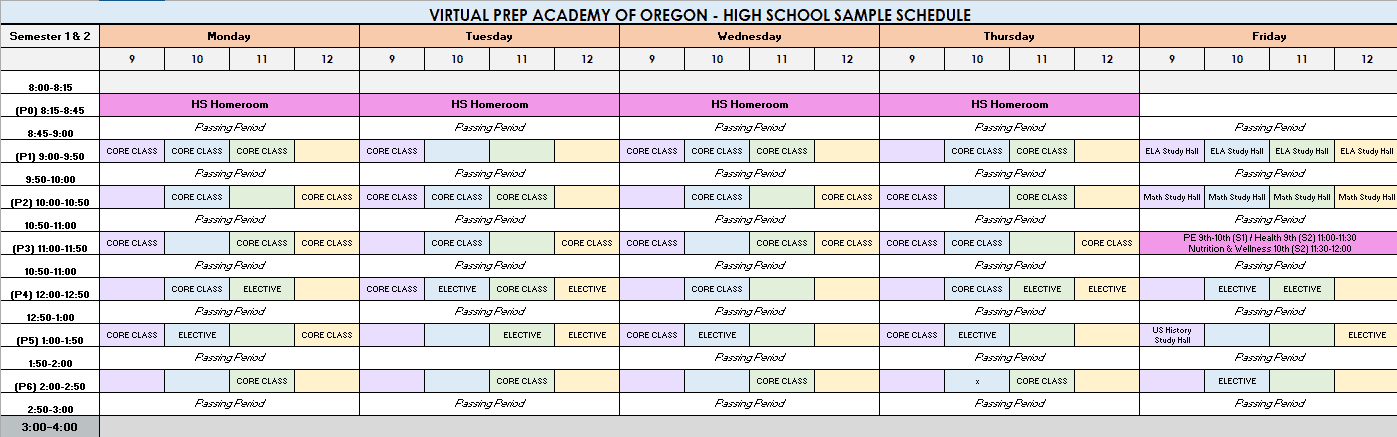
Students follow a schedule that blends live class time with independent work. This flexible online high school structure is designed to adapt to students’ pace, learning style, and life.
Certified Teachers and Academic Coaches
Licensed educators and support staff provide real-time instruction, feedback, and check-ins for academic success. No matter your goals for high school or life after, we’re here to help you reach them.
Tools that Prepare Students for Digital Literacy and Independence
Online high school programs help students learn to think deeply, use different media in their work, and become better writers. These skills prepare students for future studies and jobs in our digital world.
Benefits of Online High School
Virtual high school in Oregon empowers students to learn in a setting that’s flexible, focused, and free from unnecessary stress. Whether pursuing early graduation, recovering credits, or finding a better rhythm, the online high school model is built for real life.
Learn from Home, Free from Distractions and Peer Pressure
Students learn in a secure, stress-free environment that allows them to focus on their goals. Peer pressure, bullying, and distractions common in traditional school settings are eliminated when students choose to attend online high school.
Work at Your Own Pace, with Real-Time Support
Our online high school program for Oregon students is designed for those balancing school with health, jobs, caregiving, or extracurriculars. Dedicated teachers and admin support ensures that students can thrive – no matter their situation.
Stay on Track Toward Your Goals
Academic advisors and counselors help students stay organized, meet credit benchmarks, and plan post-graduation steps. Our goal is to help students meet theirs.
Comprehensive Online High School Curriculum
At Virtual Prep Academy of Oregon, students learn from a state-aligned curriculum. Our accredited online high school offers courses tailored to different learning styles. Core subjects lay the foundation for success. Electives allow students to explore interests and career paths.
- Core subjects: English, math, science, and social studies
- Electives: Career prep, technology, art, foreign languages, and more
- Pathways: Advanced coursework, credit recovery, and test prep options
Explore Oregon’s online academic program to learn more about course offerings.
Sample 9-12 Schedule
Curriculum, Grades 9-12
* Course offerings are subject to change and may vary based on school staffing.
US HISTORY A
US History A explores European exploration and the impact Europeans had on the lives of those native to North America. Topics included the development of the English colonies in North America, the causes and effects of the American Revolution, the ratification of the Constitution, the causes of the War of 1812, analysis of sectionalism as a common thread, westward expansion, the Civil War and Reconstruction, Indian Wars, immigration, and the Second Industrial Revolution.
Credit Recovery Course Available
US HISTORY B
US History B traces pivotal events in American history and presidential administrations as the 21st century dawns. Topics include the Gilded Age, Progressive Era, World War I, the Roaring Twenties, the Great Depression, the New Deal, World War II, the Cold War, proxy conflicts like the Vietnam War and the Korean War, technology innovations, global communications, and terrorism.
Credit Recovery Course Available
WORLD HISTORY A
World History A explores key events and historical developments from hunter-gatherer societies to the Industrial Revolution. Beginning with the analysis of prehistoric people from the Paleolithic era to the Agricultural Revolution, the course follows the rise and fall of early empires including the Roman Empire. Topics included: The Crusades, feudalism, the plague, Asian empires and trade routes, effects of the Renaissance and Protestant Reformation, and important revolutions that shaped history.
Credit Recovery Course Available
WORLD HISTORY B
World History B traces the developments of the last 250 years by examining the origins of modern Western imperialism and analyzing the cultural, economic, and political impacts on Africa and Asia. Topics include the influence of the Industrial Revolution, the effects of imperialism and nationalism on World War I, how the Treaty of Versailles contributed to the rise of fascism in Europe and the start of World War II, 20th-century warfare, the Armenian Genocide, and the Holocaust.
Credit Recovery Course Available
ECONOMICS A
This course introduces the principles and the applications of economics in everyday life. Students develop an understanding of limited resources and compare it with unlimited wants and needs. Students learn how individual and national economic decisions are made to allocate goods and services among competing users. Students apply economic principles to think and problem solve. The study of Economics uses the view of economic institutions and policies to explore the history, organization, and functions of the U.S. government in controlling our economy. It offers students learning opportunities that build one on another. A goal of the course is for the student to develop the critical skills of analysis, synthesis, and evaluation in a demanding and thoughtful academic setting. Students are encouraged to use their knowledge of the policies and institutions of economics to develop their own views on current economic and monetary issues. They are taught how to apply what they have learned into personal financial activities. The course looks closely at the economic knowledge and values of the country and gives students a look into the problems faced by presidents and congressional representatives. It also covers the roles of political activists, political parties, interest groups, and the media in shaping the U. S. economy. The Supreme Court is presented as the voice of reason in the balance of powers. Students are encouraged to perform at higher levels as they are presented with historical documents and additional readings, work with a set of facts arranged by theme, become skillful in note-taking, and join in student discussions. Students develop and demonstrate their writing skills by preparing extended research-based papers.
Credit Recovery Course Available
CIVICS AND GOVERNMENT
This course will guide students through an in-depth study of the history, structure, and guiding principles of American government. The first unit will review the origins of government in general and American government in particular—from the earliest models for democracy to the founding documents that created a federalist system of government in the U.S. Several units will help students explore the roles and responsibilities of each branch of government as well as the impact that the Constitution has had and continues to have on the way government works and on the lives of individual Americans. The course’s final unit will guide students through a series of projects that require them to apply what they have learned about American government to an issue that interests them.
Credit Recovery Course Available
ENGLISH 9 A
English 9 A explores reading, writing, and analysis using both informational and literary texts, as well as comparing texts in different mediums. Readings include The Princess and the Goblin by George MacDonald, among others, to demonstrate an understanding of textual evidence, themes, central ideas, inferences, word choice, figurative and connotative language, and grammar and usage. Writings include a personal narrative (memoir) and a literary analysis.
Credit Recovery Course Available
ENGLISH 9 B
English 9 B explores reading, writing, and analysis using informational and literary texts. Readings include Anthem by Ayn Rand, among other texts of varying periods, to demonstrate concepts such as textual evidence, themes, central ideas, characters, inferences, rhetorical techniques, structure and style, and arguments and claims. Writing topics include grammar, usage, punctuation, spelling, style manuals, phrases, and clauses, culminating in informational and argument essays.
Credit Recovery Course Available
ENGLISH 10 A
English 10 A examines reading, writing, and analysis of informational texts, argument texts, and videos to demonstrate understanding of explicit and inferred meaning, textual evidence, central ideas, arguments and claims, organizational structures, figurative and rhetorical language, and the effect of word choice on tone. Skill building focuses on spelling, grammar, usage, punctuation, domain-specific vocabulary, context clues, and affixes. Writing topics include an informational essay and an argument essay.
Credit Recovery Course Available
ENGLISH 10 B
English 10 B explores reading, writing, and analysis of literary texts from around the world and across history. Readings include Antigone by Sophocles, among others, to demonstrate an understanding of textual evidence, themes, inferences, characterization, figurative language, figures of speech, and literary devices, as well as building a foundational knowledge of context clues, word nuances, affixes, phrases, clauses, and parallel construction. Writing topics include a literary analysis essay and a personal narrative essay.
Credit Recovery Course Available
ENGLISH 11 A
ELA for eleventh graders centers on the study of American literature and the evolving ideas, voices, and tensions that have shaped the nation’s history. Each semester, students engage in an individual, inquiry-based exploration in which they investigate a topic connected to their future goals and curate a portfolio of real-world writing and communication artifacts.
Credit Recovery Course Available
ENGLISH 11 B
Across the course, students read literary and informational texts to deepen comprehension, analyze ideas and author’s craft, and evaluate how language, structure, and rhetoric shape meaning. They write routinely in multiple modes, participate in collaborative discussions, conduct research, and reflect on how literature connects to both American society and their own experiences. The course emphasizes critical thinking, effective communication, and preparation for college, career, and civic life.
Credit Recovery Course Available
ENGLISH 12 A
ELA for twelfth graders focuses on world literature and global perspectives, exploring how writers across cultures and time periods examine shared human experiences. Each semester, students complete an individual, inquiry-based project that allows them to investigate a topic of personal or academic interest and develop a portfolio of authentic, real-world writing and presentation artifacts.
Credit Recovery Course Available
ENGLISH 12 B
Students analyze how authors use language, structure, and rhetoric to convey ideas, explore cultural values, and respond to historical and social contexts. Throughout the course, students engage in research, write in a variety of modes over both extended and shorter time frames, and participate in meaningful discussions and presentations. The course supports students in synthesizing ideas across texts and cultures while preparing them for postsecondary study, professional communication, and independent thinking.
Credit Recovery Course Available
ALGEBRA 1 A
Algebra 1 A explores the application of properties to simplify expressions with exponents and radicals, relationships between rational and irrational numbers, solving linear equations and inequalities, applying knowledge of linear equations and inequalities to solve and graph systems of linear equations and inequalities, applying operations on polynomials, factoring quadratic expressions, and solving quadratic equations using different methods.
Credit Recovery Course Available
ALGEBRA 1 B
Algebra 1 B explores the analysis of different types of functions presented as equations, graphs, tables, and verbal descriptions, identifying key features applied to real-world problems, using key features to compare different types of functions, transformations of functions, statistics, interpreting and analyzing data sets, as well as causation and correlation.
Credit Recovery Course Available
ALGEBRA 2 A
Algebra 2 A explores solving quadratic equations with complex solutions and performing operations on polynomials. It uses polynomial identities to solve problems, analyzes polynomial functions using different representations, and solves polynomial equations graphically. It also works with rational functions and performs arithmetic operations on rational functions to graph them.
Credit Recovery Course Available
ALGEBRA 2 B
Algebra 2 B explores radical equations, rewriting expressions involving radicals, and graphing and solving radical equations. Trigonometry concepts include ratios and using the unit circle to understand them, graph sine, cosine, and tangent functions, and use key features to prove and apply trigonometric identities.
Credit Recovery Course Available
GEOMETRY A
Geometry A explores writing formal proofs and constructing geometric figures. Topics include transformations to explain the concepts of congruent and similar figures, focusing on the properties of congruent and similar triangles. Properties are proved with postulates, theorems, and formal proofs, as well as trigonometric ratios and their applications to real-world situations.
Credit Recovery Course Available
GEOMETRY B
Geometry B explores writing formal proofs and constructing geometric figures. Topics include slopes, midpoints, distance formulas focusing on their applications in coordinate proofs, theorems about circles, concepts related to circles, and two- and three-dimensional figures and probability.
Credit Recovery Course Available
PRE-CALCULUS A
In this course, students will understand and apply concepts, graphs and applications of a variety of families of functions, including polynomial, exponential, logarithmic, logistic and trigonometric. An emphasis will be placed on use of appropriate functions to model real world situations and solve problems that arise from those situations. A focus is also on graphing functions by hand and understanding and identifying the parts of a graph. A scientific and/or graphics calculator is recommended for work on assignments, and on examinations.
Credit Recovery Course Available
PRE-CALCULUS B
Pre-Calculus Part B covers the major units of Introductory Trigonometry and Graphs, Trigonometric Equations and Identities, Analytical Trigonometry, Sequences and Series, Conic Sections and an Introduction to Calculus. A focus is also on graphing functions by hand and understanding and identifying the parts of a graph.
Credit Recovery Course Available
PRE-ALGEBRA A
Read, set, go! Pre-Algebra is all about training to run the race of high school math. Students will strengthen their skills in topics like linear relationships, functions, and equations, and learn new skills that prepare them for Algebra 1. This course is designed with interactive learning and real-world activities to strengthen students’ math muscles for the race ahead.
Credit Recovery Course Available
PRE-ALGEBRA B
Read, set, go! Pre-Algebra is all about training to run the race of high school math. Students will strengthen their skills in topics like linear relationships, functions, and equations, and learn new skills that prepare them for Algebra 1. This course is designed with interactive learning and real-world activities to strengthen students’ math muscles for the race ahead.
Credit Recovery Course Available
APPLIED MATH
Students learn to apply the skills they learn to solve real-life problem, and analyze current financial issues of taxes, loans, car leases, mortgages, insurance. Mathematical processes are used to study patterns and analyze data, algebraic formulas, graphs, amortization modeling. Schools may use this course independently or pair with Applied Mathematics to create a Math Models full-year course.
Credit Recovery Course Available
FINANCIAL MATH
We all know money is essential in life, and the financial decisions you make today may have a lasting effect on your future. Explore how to spend and save your money wisely, and learn key financial concepts around taxes, credit, and money management. Discover how education, career choices, and financial planning can lead you in the right direction to making your life simpler, steadier, and more enjoyable.
Credit Recovery Course Available
BIOLOGY A
Biology A examines the basics of biochemistry and how it helps understand biological systems on Earth. Students will use logical thinking to identify relationships and draw conclusions. The course covers the building blocks of biochemistry, individual cells, cell membranes, cell division, reproduction, cell energy and metabolism, and photosynthesis.
Credit Recovery Course Available
BIOLOGY B
Biology B examines the basics of genetics, natural selection, ecology, model how matter and energy flow through ecosystems, and the technology to see the larger context and implications. Topics included: biological research topics of ethical guidelines in new biotechnology.
Credit Recovery Course Available
PHYSICAL SCIENCE A
Physical Science A examines science and covers how methods and tools provide scientists with meaningful results. Topics include chemistry to interpret chemical names, formulas, equations, and models to discover the types and properties of reactions and nuclear reactions and their uses, historical perspectives, and social impacts.
Credit Recovery Course Available
PHYSICAL SCIENCE B
Physical Science B explores physics, introduces topics in engineering, and explains the ways scientists think, communicate, and do their jobs. The topics of motion and force, including the motion of fluids and Newton’s law, build a foundation for exploring thermodynamics, energy, work, machines, waves, electricity, and magnetism.
Credit Recovery Course Available
EARTH SCIENCE A
The first three modules of Semester 1 cover Scientific Inquiry, the Structure and Composition of the Universe, and the Features of the Solar System. Students learn the importance of scientific inquiry and how to communicate the results of scientific investigations. They then have material on the formation of the universe, including the Big Bang Theory, the motions of celestial objects, and stellar evolution. The third module covers material related to the Solar System, including features of the Sun and the planets and the movements of Earth. The second three modules of Semester 1 cover Weather, Climate, and Earth’s Water Cycle. Students first learn in Module 4 about the atmosphere and clouds, as well as the factors that influence local and global climate. In Module 5 they continue by learning about weather and air masses, meteorology and storms. Module 6 then discusses the water cycle, including groundwater and ocean features, as well as water scarcity and pollution.
Credit Recovery Course Available
EARTH SCIENCE B
The first three modules of Semester 2 cover the physical structure of the Earth and Earth’s tectonic system, including the rock cycle, tectonic activity, and mountain building. It then covers weathering and erosion and soil formation. The next material in the course then addresses the concept of systems; it addresses the Earth as a system, feedback in systems, and Earth’s major nutrient cycles. The second three modules of Semester 2 cover geologic history, including the evolution of Earth’s atmosphere, the geologic time scale, and the fossil record. It then goes over natural resources and the effects of human population on natural resources. The course wraps up with a discussion of human society and its interconnectedness with the Earth’s environment, how science and technology work together, and the technological design process in earth science applications.
Credit Recovery Course Available
SPANISH 1
Open the door to all the possibilities of your Spanish language passport! Sip your virtual cafecito as you delve into topics like school, daily escapades, food preferences, nationalities, family, sports, music, clothing, transportation, and weather. On this journey you’ll unearth a trove of cultural gems, discovering the richness of different Spanish-speaking countries through breath-taking locations, unique celebrations, and cherished traditions. Your goal is to master the basics—the key to unlocking Spanish conversations. Are you prepared for this exciting new adventure?
SPANISH 2
Get ready to immerse yourself on a journey towards Spanish fluency! Along this language path, you’ll explore facets of your home life, daily routine, health, cherished memories, travel must-haves, and visions of career plans. You’ll gain the skills to talk about your life—past, present, and future—and increase your conversational expertise. Along the way, you’ll meet Spanish-speakers from around the world to gain their perspectives on unique cultural traditions, pastimes and celebrations and explore the bustling cities, astonishing architecture, wonders of nature, and vibrant colors of their diverse countries. Are you ready for this exhilarating adventure?
SPANISH 3
Immerse yourself in the vibrant tapestry of Hispanic culture spanning the globe. Explore the sensory delights—flavors, vistas, and melodies—woven into this dynamic language, which echoes triumphs, struggles, and jubilant celebrations. As you delve deeper, you’ll embrace global citizenship by discovering the Hispanic influence on the global world, its ancient histories, and its harmonious blend with modern life in diverse countries. From captivating art and timeless literature to myths and legends, this cultural odyssey will hone your conversational and writing skills through authentic tasks. So, pack your linguistic bags—no passport required—and elevate your Spanish proficiency to new heights!
ART HISTORY 1
This Art History course integrates the four components of art study: art production, historical and cultural context, critical process, and aesthetic process. Students will be able to identify and describe art from prehistoric times to modern time. Throughout this course, students will discuss various artworks, research artists, and create documents and presentations demonstrating concepts learned.
ART IN WORLD CULTURES
Art tells a story. Go on a journey of when humans began creating art in prehistoric times to ancient Roman, early Christian, and Medieval periods. Explore the artistic characteristics of the Renaissance, Americas, Baroque, Romantic, and more. Learn the elements and design principles of art, and about some of the greatest artists in the world, while creating your own art, both on paper and digitally. It’s time to tell your story through art.
BASIC DRAWING
In Drawing, students will experiment with several different art materials and tools to see what each tool can do best. Students will explore ordinary things around them to become more observant of the structures and meanings of things which can be seen in their home and community. Student work will be their own study of the forms, textures, movements, and patterns of the things that are seen every day. Each project and each lesson is based on the one before it; so lessons should be completed in the order they are given. Directions should be followed exactly regarding which materials, sizes, and subject matter to use for each project. Each lesson will be a study of a new way of drawing. The examples given will show only the method and materials to be used, never the same subject or size as the project assigned. The examples are never to be copied. An example will only show one way of using the technique described.
WORKPLACE READINESS
Starting your first “real” job can be intimidating. But when you know what to expect and learn how to be successful, you’ll feel confident about the hiring process and prepared to put yourself out there! Discover how to build a well-rounded set of employability and personal leadership skills that allow you to guide your own career. Learn how to communicate with others, take initiative, set goals, problem-solve, research different career options, and envision your own personal career path. Get ready to create a powerful launching pad that will help you blast off into a great first job experience!
PRINCIPLES OF IT A
Ready to develop your understanding and proficiency in computers? Explore a range of concepts to gain the foundational knowledge you’ll need to start exploring careers in this field to find out which ones suit your interests and abilities. Learn about computer hardware and maintenance to data management and storage options to network systems, administration, and troubleshooting. Then dive into word processing, spreadsheets, and databases to cement your knowledge of information technology!
PRINCIPLES OF IT B
Take the IT knowledge you have to a more advanced level. Starting with an overview of programming, algorithms, and compilers, you’ll then learn the basics of web page design and creating graphics. Explore security and cybercrime, emerging technologies, presentation software, and intellectual property laws. Finally, you will prepare for the future by discovering various careers in this field and planning your education!
CAREER DISCOVERY
Helps students explore career paths, develop employability skills, and create educational and career plans.
LEARNING IN A DIGITAL WORLD
The digital world seems to change every day, and touch more of our lives. We use technology to communicate with friends and family, find neverending entertainment options, follow our favorite sports teams and fashion trends, and do our school work. In Learning in a Digital World you will get the tools to navigate this exciting and always changing world. Learn about real-world issues and how to solve real-world problems through interactive and hands-on assignments. Discover what it means to be a responsible digital citizen, expand your digital literacy, and become a successful online student. Consider the best ways to find, create, and share information, learn to maximize information and communication technologies, and explore digital content creation, from emails and blogs to social media, videos, and podcasts.
PROGRAMMING 1
Introduces students to software development, programming concepts, and problem-solving through languages like Python. Covers algorithms, data, debugging, and program design.
PROGRAMMING 2
Builds on Programming I by introducing more advanced topics such as multiple programming languages, HTML/CSS/JavaScript, API integration, and GUI development.
AP COURSES
AP English Language and Composition
AP English Literature and Composition
AP Calculus AB
AP Calculus BC
AP Biology
AP Chemistry
CREDIT RECOVERY
Our Credit Recovery courses are designed to serve students seeking to recapture credit for courses previously taken. Our credit recovery courses are the same scope and sequence as original credit courses, however, some teacher-graded assignments have been removed from the course to accelerate the student’s path.
Graduating from an Online High School
Oregon Virtual Prep’s approach to online education prepares teens to pursue higher education and enter the workforce. Our high school students graduate with a state-recognized Oregon diploma. Whether catching up or looking ahead, we’ll help you reach your finish line.
Graduation Requirements
The curriculum is designed to have all students meet the Oregon high school graduation requirements. Students earn credits in core subjects and electives to prepare them. Benchmarks along the way ensure they’re on track.
Post-Graduation Opportunities
Our graduates pursue college, career training, the military, or jobs – equipped with real skills and confidence. The foundation built here sets students up for post-graduation success.
Student Success Stories
From first-generation graduates to career-focused students, our community includes learners who’ve overcome setbacks and earned scholarships and certifications. More than 90% of families who’ve attended VPREP report their experience and education as being.
Teacher and Peer Interactions
Virtual doesn’t mean isolated. Online high school classes in Oregon let students connect through live discussions, collaborative projects, and virtual clubs. Students build community during group classes, clubs, and more. Meet the teachers who balance academic rigor and social development every day.
Parental Involvement and Support
Parents and guardians play an important role in student success. While students grow more independent, we keep families informed and empowered. Our team provides onboarding, progress updates, and tools that support families. Online learning parent and student resources help learners and families succeed.
Ensuring Student Success
From the first day of enrollment through graduation, Virtual Prep Academy of Oregon is committed to student success at every level. Whether your child begins in our online elementary school program, progresses through our virtual middle school, or joins us in high school, they’ll receive personalized academic support, access to counselors, and guidance tailored to their goals and learning pace. Our flexible plans, proactive communication, and student-centered approach help students thrive in every grade level.
FAQs
Curious about how virtual programs compare to traditional schools? We’ve got answers to common questions about online high school.
Is Oregon’s Virtual Prep’s online high school free?
Yes! Virtual Prep Academy of Oregon is a tuition-free public school for students in grades 9-11 residing in Oregon. There is no enrollment fee either.
How does Oregon’s Virtual Prep’s high school work?
VPREP students attend live classes online, complete independent assignments, and get support from teachers and success coaches. The coursework is aligned with the state’s curriculum and is provided 100% virtually.
Do colleges accept online high school programs from Oregon?
Absolutely. Our program is accredited, and our diploma is accepted by 2- and 4-year colleges, trade schools, employers, and the military.
What does online high school coursework look like?
Students take core subject classes like English, math, science, and social studies. Electives in career prep, technology, art, language, and more are flexible and personalized by students to meet their goals.
Enroll Today in Virtual Prep Academy of Oregon’s Online High School
Start your path to a flexible, supported, tuition-free high school education today. Enroll online in minutes!
Request Information
Fill out the form to receive more information about our school